Air-conditioning, cold freezers and electronic scanning: when we go shopping, we take all of those things for granted, since we are used to them. But facing the truth, all those factors are luxuries, at least compared to the 986 million people (in 2007) in the world who live in poverty. This number has already decreased since 2005, when the poverty rate was 1.4 billion, but this is not due to more food or money, but because the subject of poverty is better understood in the world.
According to the World Bank, the cost of living was underestimated in many countries, since it was much steeper than expected. After the "poor" were recounted in the world, the poverty line was drawn equivalent to someone living on 1.25 dollars a day in America in 2005. Critics of this approach argued that the cost of living estimates are based on the a normal representative household, but according to critics, the poor are not representative. After this, the Asian Development Bank made a study of the prices in many Asian countries, and the results showed that the poor in 9/16 countries pay less. Therefore, the theory of poverty has to be reviewed. Now the World Bank hopes for an even lower poverty rate in the next years.
The Economist
The bottom 1.4 billion
Aug 28th 2008 DELHIFrom The Economist print edition
http://www.economist.com/finance/displaystory.cfm?story_id=12010733
9/24/08

9/22/08
Grunge and the Seattle Scene
In the mid 80s a new movement was developing in Seattle, Washington which is known as grunge and is largely due to bands such as Nirvana and Pearl Jam. It combined alternative music, which was largely underground rock bands, and grunge, bands that combined punk, guitar rock and metal. This scene happened in Seattle, which was in the mid 80s quite desolate, but due to the constant rain there people started to meet indoors and bands played their songs. Then in 1988 the record label Sub Pop created the Sub Pop Singles Club, and bands such as Nirvana became known in Seattle.
With the arrival of a British journalist who observed the scene, the grunge style suddenly got more attention. After Nirvanas second album “Nevermind” came out, MTV played Nirvana nonstop and suddenly everyone knew them. But as successful as they were, marketing such as the Vanity Fair magazine made a grunge fashion line, and the style became familiar, not rebellious and unique as it was intended. Rumors and gossip surrounded the new “celebrities” of grunge rock, and the unofficial spokesman of the grunge scene, Kurt Cobain from Nirvana, killed himself in 1994. The grunge music however is still with us today and fascinates many people worldwide.
With the arrival of a British journalist who observed the scene, the grunge style suddenly got more attention. After Nirvanas second album “Nevermind” came out, MTV played Nirvana nonstop and suddenly everyone knew them. But as successful as they were, marketing such as the Vanity Fair magazine made a grunge fashion line, and the style became familiar, not rebellious and unique as it was intended. Rumors and gossip surrounded the new “celebrities” of grunge rock, and the unofficial spokesman of the grunge scene, Kurt Cobain from Nirvana, killed himself in 1994. The grunge music however is still with us today and fascinates many people worldwide.
9/17/08
No Logo Chapter 2
“Clothing has become an empty carrier of the logo itself” is what Naomi Klein expresses at the beginning of the second chapter of No Logo. The idea is that brands are getting bigger and embody not only a lifestyle but culture itself. In the mid 90’s some brands went a step further and started to sponsor cultural event, in order to add value to the brand. The brand is therefore directly connected to an event and fully embodies a lifestyle that everyone is familiar with and likes. An example of this is the Christmas decoration sponsored by Yves-Saint-Lauren, which was put up under the condition that their logo was printed onto the lights. Another idea introduced in the chapter was “co- branding”, the idea that celebrities are linked to a certain brand. Michael Jordan is connected to Nike, just like Roger Federer is. This allows the brand to expand and make it more popular. Advertisements through product placement in media or through music such as concerts were also successful and brands sold a lifestyle that was mirrored in events and famous people that the demographic looked up to.
9/15/08
Poverty in Somalia
Somalia
Hunger and terror
Sep 4th 2008 NAIROBI
From The Economist print edition
There has been no pause in the country’s relentless downward spiral
IT HAS been a long, dreadful summer for Somalia. The UN says that 3.2m Somalis (out of about 8m) now need aid just to stay alive: a 77% rise on last year. A sixth of Somali infants are at risk of starving to death. Due to what aid organisations call “intolerable insecurity”, almost all international charity workers have left. Offshore, Somali pirates are as bold as ever. They are holding around ten vessels, including three large tankers with 130 crewmen captured this week.
Foreign governments still wrangle over Africa’s worst humanitarian and political crisis. UN people working for a deal between Islamist insurgents and the weak Somali government want 8,000 peacekeeping troops to replace the few thousand beleaguered African Union and Ethiopian soldiers. But more senior people in the UN’s peacekeeping office, already failing to get enough troops into Darfur, rule that out. A multinational force would be the next best thing, but who would pay? Mooted Saudi cash has not materialised.
Optimists point out that Somalia’s transitional government has at least not collapsed altogether. The prime minister, Nur Adde Hussein, survived a vote of no confidence from the parliament this week. The president, Abdullahi Yusuf, is apparently no longer standing in the way of national reconciliation. Ethiopia’s prime minister, Meles Zenawi, whose forces invaded Somalia with American backing in 2006, has hinted he may withdraw them. Hardline Islamists of the Alliance for the Reliberation of Somalia (ARS) have joined with the more moderate Islamists of the Islamic Courts Union at peace negotiations in Djibouti. The rump of the ARS, led by the former Somali army colonel, Hassan Dahir Aweys, says it will sign a ceasefire only if the Ethiopians go.
Even then, the Islamic Courts’ former military wing, known as the Shabab (meaning Youth), would fight on. Its men have been radicalised by the insurgency and have grown in confidence (or fatalism) since being classified as a terrorist group by the American administration. One of its commanders, Mukhtar Robow, wants to merge it with al-Qaeda. Together with local clan factions, the Shabab took control of the southern port of Kismayo on August 24th. A video released on jihadist websites shows Saleh Ali Nabhan, an al-Qaeda man believed to responsible for the bombing of the American embassy in Nairobi in 1998 and now sheltered by the Shabab, appealing for African Muslims to fight a holy war in Somalia. Foreign fighters are unlikely to sway a new battle for Mogadishu, the capital. But a flow of Somalis into al-Qaeda would be bad news for global counter-terrorists.
Pasted from <http://www.economist.com/world/mideast-africa/displaystory.cfm?story_id=12059342>
The Death of Somalia
In the past year, poverty has increased in Somalia by 77%. Due to "intolerable insecurity", as it is described by aid organizations, all international charity workers leave the country, and the Somalis are left to themselves. This humanitarian crisis that is causing the deaths of many people seems to be directly linked to the political problems in the country, causing more negative than positive aspects.
UN plans like the exchanging of African Union soldiers in Somalia by 8000 peacekeeping troops, and the establishment of a multinational force are turned down due to expenses and failure of similar plans in Darfur. There are a few positive factors, such as that the transitional government is still standing and that the Ethiopian forces invading the land might withdraw. Moderate and hardline Islamists also try to establish peace treaties in Djibouti. But the shadow of all these "positive" events is that the military wing "Shabab" fights on. Classified by the American administration as terrorists, the fear of counter- terrorists is that they’ll merge with al-Qaeda. This tenses up the situation for the Somalis, and increase the poverty and killing in the country. The politics in Somalia are surely not the only reason why men, women and children die, but it is an influential contributor.
Melissa John
9/10/08
lifestyle and product advertisements


1) The first advertisement for twix is an example of a product being sold. In this case, the twix bar is being sold by showing that the guy whos eating it likes it, and that he can relax when eating Twix.
2) The second is an example selling a lifestyle. The tommy hilfiger perfume add doesnt just sell the perfume, it sells the whole idea of friendship and being together, happiness and socializing, all by showing a group of people that are happy to be together. Everyone who sees this add will automatically connect freedom and frienship with this perfume; selling a lifestyle.
9/8/08
No Logo 1st chapter summary
No Logo 1st Chapter
The first chapter of No Logo, by Naomi Klein, talks about the emergence of brands and how companies started to emphasize on selling brand names instead of the products themselves. In the 1980s, the corporations and big brands that came about started to rely more on marketing instead of selling. Before that, the products where sold as coffee, tea, cookies, but with the emergence of brands the competition on the market grew and suddenly ‘Jacobs’ and ‘Colgers’ coffee gave the customer a choice. Brands were a way of separating from the competition and selling your product through marketing in a special and different way: through a lifestyle and logos, such as McDonalds golden arches. The lifestyle sold to the customer through the brand showed familiarity and quality, and caused a sudden boom in the growth of industries. Another event that led to the increase of brands was Philip Morris buying "Kraft" for 12.6 billion dollars in 1988. Wall Street, a few years later, declared brands as dead, but the companies/brands started to advertise their products and many survived the Wall Street crash. One great example of such a brand and logo is Marlboro and the Marlboro man, who is one of the first brands with a logo, and also one which has been successful for a long time. No Marlboro Friday or cutting prices stopped many companies from their success, and today our lives are overflowing with brands and advertisements.
The first chapter of No Logo, by Naomi Klein, talks about the emergence of brands and how companies started to emphasize on selling brand names instead of the products themselves. In the 1980s, the corporations and big brands that came about started to rely more on marketing instead of selling. Before that, the products where sold as coffee, tea, cookies, but with the emergence of brands the competition on the market grew and suddenly ‘Jacobs’ and ‘Colgers’ coffee gave the customer a choice. Brands were a way of separating from the competition and selling your product through marketing in a special and different way: through a lifestyle and logos, such as McDonalds golden arches. The lifestyle sold to the customer through the brand showed familiarity and quality, and caused a sudden boom in the growth of industries. Another event that led to the increase of brands was Philip Morris buying "Kraft" for 12.6 billion dollars in 1988. Wall Street, a few years later, declared brands as dead, but the companies/brands started to advertise their products and many survived the Wall Street crash. One great example of such a brand and logo is Marlboro and the Marlboro man, who is one of the first brands with a logo, and also one which has been successful for a long time. No Marlboro Friday or cutting prices stopped many companies from their success, and today our lives are overflowing with brands and advertisements.
8/31/08
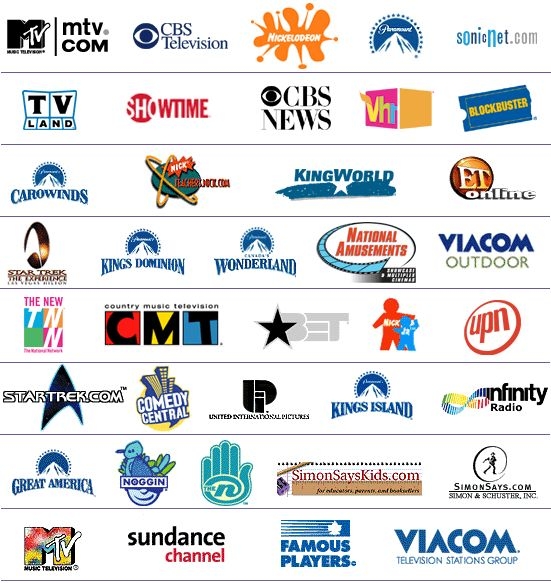
list of companies owned by viacom

Companies owned by Viacom
Radio Networks
· Infinity Broadcasting (manages Westwood One Radio Network)
· Metro Networks
Radio Networks
· Infinity Broadcasting (manages Westwood One Radio Network)
· Metro Networks
Radio Stations
·
Internet
·
· CBS Internet Group
· Nickelodeon Online
· BET.com
· Contentville.com (35%)
· Neopets
· SportsLine.com
Film Production and Distribution
·
· MTV Films
· Nickelodeon Movies
· Republic Pictures
· United International Pictures (50%)
· DreamWorks
Theme Parks
·
Publishing
·
· MTV Books
· Nickelodeon Books
· Simon & Schuster
· Pocket Books
· Scribner
· Touchstone
Television Networks
·
· UPN
· MTV
· Nickelodeon/Nick at Nite
· TV Land
· CMT
· Spike TV
· Paramount Comedy*
· VH1
· Noggin/The N
· Showtime Networks
· Showtime
· The Movie Channel
· Sundance Channel (joint venture with Robert Redford and NBC Universal)
· FLIX
· SET Pay-Per-View (sporting and entertainment events)
· BET
· Comedy Central
· TMF*
· VIVA*
Television Production and Distribution
·
· Spelling Entertainment Group
· Big Ticket Television
· Viacom Productions
· King World Productions
· CBS Productions
· CBS Broadcast International
· Eyemark Entertainment
· CBS Paramount International Television
Television Stations
· 17 CBS-affiliated stations
· WCBS New York, New York
· KCBS Los Angeles, California
· WBBM Chicago, Illinois
· KYW-TV Philadelphia, Pennsylvania
· KPIX San Francisco, California
· WBZ Boston, Massachussetts
· KTVT Dallas/Fort Worth, Texas
· WWJ Detroit, Michigan
· WCCO Minneapolis/St. Paul, Minnesota
· WFOR Miami, Florida
· KCNC Denver, Colorado
· KOVR Sacramento, California
· KDKA Pittsburgh, Pennsylvania
· WJZ Baltimore, Maryland
· KUTV Salt Lake City, Utah
· KEYE Austin, Texas
· WFRV Green Bay/Appleton, Wisconsin
· 19 UPN-affiliated stations
· WPSG Philadelphia
· KBHK San Francisco
· WSBK Boston
· KTXA Dallas/Fort Worth
· WUPA Atlanta, Georgia
· WKBD Detroit
· KSTW Seattle/Tacoma, Washington
· WTOG Tampa, Florida
· WBFS Miami
· KMAX Sacramento
· WNPA Pittsburgh
· WTVX West Palm Beach, Florida
· WGNT Norfolk, Virginia
· KAUT Oklahoma City, Oklahoma
· WLWC Providence, Rhode Island
· WUPL New Orleans, Louisiana (pending sale to Belo)
· 1 The WB affiliate
· WTCN West Palm Beach
· 1 Azteca America affiliate
· WWHB West Palm Beach
· 1 independent station
· KCAL Los Angeles
Source used:
http://www.spiritus-temporis.com/list-of-assets-owned-by-viacom/
http://media.indypgh.org/uploads/2003/11/viacom.jpg
Subscribe to:
Posts (Atom)